Broccoli
Also called: بروكلي · قرنبيط أخضر · Broccoli
Easier than cauliflower and it pays twice: one main head, then weeks of side shoots. The same timing as cabbage — nursery in September, transplant in October.
The year at a glance
Each month is split in half. The outline marks now.
Stage by stage
Stage 1 of 7
Seed
Days 0–4
Seed
Days 0–4The seed sits in the soil taking up water and swelling. Nothing shows above the surface — everything is happening underground.
Do now
- Water lightly and often so the soil stays damp but never soaked. Letting it dry out between waterings kills the seed before it sprouts.
- Cover the surface with a thin layer of straw or compost to slow evaporation and steady the temperature.
- Label what you sowed and when. You will need the date to work out the harvest.
Watch for
- A hard crust forming on sandy soil after watering, which traps the sprout underneath. Break it gently.
- Ants carrying small seeds away — a very common problem in Qatari gardens.
In Qatar
Start in trays under shade in late September. Broccoli will germinate in slightly warmer soil than cauliflower, but needs cool weather after that.
Germination
Days 5–9The seed coat splits: a root pushes down and a shoot pushes up. The two seed leaves that appear are not true leaves — they are the seed’s own food store.
Do now
- Keep moisture constant. The first root is very fine and a single dry day can end the seedling.
- Remove any covering as soon as the first sprout shows, or it will stretch thin looking for light.
- Give bright, indirect light. Direct midday sun will scorch a new seedling within hours.
Watch for
- A long, thin, pale stem: the seedling is not getting enough light and will collapse.
- Sudden wilting with a pinched stem at soil level — damping off, caused by overwatering.
In Qatar
Fast and even. Keep the surface damp and the tray out of direct afternoon sun.
Seedling
Days 10–29The first true leaves appear, shaped differently from the seed leaves. The plant is now feeding itself and the roots are branching fast.
Do now
- Thin crowded seedlings and keep the strongest. Crowding gives you many weak plants instead of one good one.
- Start watering less often but more deeply, to drive the roots downwards.
- Harden the seedling off — build up its sun exposure over a week before transplanting.
Watch for
- Yellowing lower leaves: nitrogen shortage, very common in Qatar’s poor sandy soil.
- Small holes or chewed edges, meaning snails or young grasshoppers.
In Qatar
Harden off over a week and transplant in mid-October. Broccoli is more forgiving than cauliflower of a slightly late transplant.
Leaf growth
Days 30–54Leaves multiply fast and the rosette widens. All the energy goes into leaf — which is the crop itself, so speed is the goal.
Do now
- Feed nitrogen every ten days. Leafy crops want more of it than anything else you grow.
- Keep the moisture even. Any drought turns the leaves bitter and tough, permanently.
- Clear competing weeds. Leafy crops root shallowly and lose the competition easily.
Watch for
- Small, thick, dark leaves: the plant is thirsty or the soil is salty.
- Aphids gathering in the heart of the plant, where they are hard to wash out.
In Qatar
Feed nitrogen every ten days through November to build a dense canopy, then stop when the head starts. More leaf now means a bigger head.
Head forming
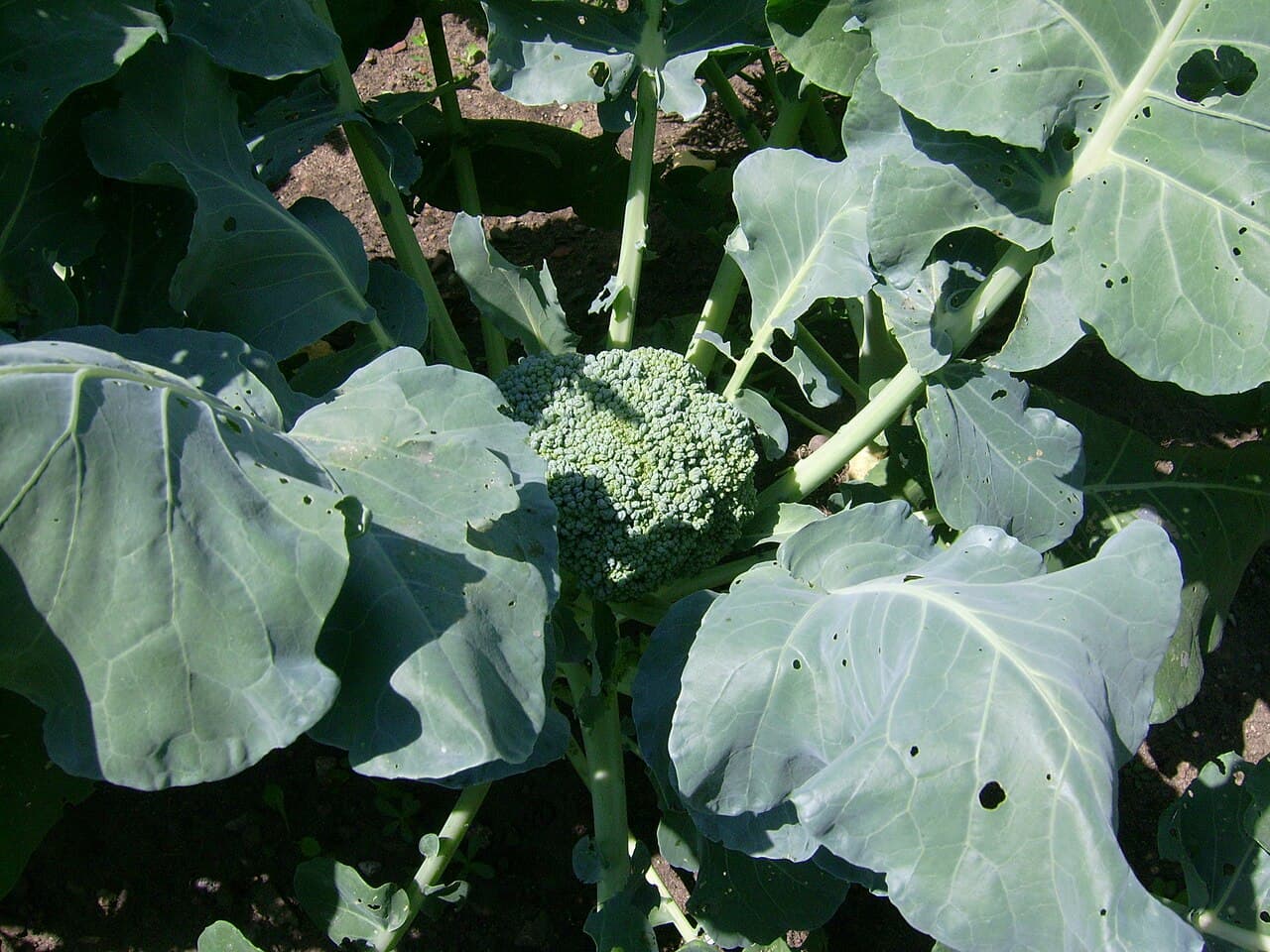
Days 55–69A green head of tightly packed flower buds appears at the centre. Unlike cauliflower it is not covered — it needs light to stay deep green.
Do now
- Keep the water steady. Any drought now gives a small, loose head.
- Stop nitrogen and give potassium to keep the buds tight.
- Check the head daily. The buds open within a day or two once it reaches full size.
Watch for
- A tiny, button-sized head: the heat came early, or the seedling sat too long in its tray.
- Buds yellowing at the edges: it is about to open, so cut it straight away.
In Qatar
The head forms best in December and early January. A February warm spell opens the buds in a single day.
Harvest and side shoots
Days 70–110The main head is ready. After you cut it the plant sends out smaller side shoots for weeks, so one plant gives you one crop after another.
Do now
- Cut the main head with 15 cm of stem on a slant in the early morning, before the buds open.
- Keep watering and feeding after cutting; the side shoots need fuel.
- Pick the side shoots every three or four days while they are still tight.
Watch for
- Yellow flowers showing — too late, and open buds taste weaker.
- March warmth shutting the side shoots down abruptly.
In Qatar
The harvest runs December to March. Side shoots last longest through Al-Murabbaniya and stop altogether with March warmth.
End of cycle
Days 111–135The plant’s cycle is over. The roots left behind break down and add organic matter if you leave them.
Do now
- Cut the plant at soil level and leave the roots in place to rot down.
- Sow a crop from a different family in the same spot to break the pest cycle.
- Add compost and cover the soil before the summer heat.
Watch for
- Planting the same family twice running in the same bed.
- Leaving the soil bare in the sun all summer.
In Qatar
Pull the plant when the side shoots stop. Compost the healthy remains and keep brassicas out of that bed next season.
- Water
- High
- Salt tolerance
- Medium
- Heat tolerance
- Low
8 L/week in winter, 18 L in summer
Soil preparation
Work in 5 kg of well-rotted compost per square metre and a little gypsum. It takes more salt than cauliflower but dislikes compacted ground.
Pests
Cabbage worm
- Sign
- Green caterpillars and dark green droppings in the middle of the head.
- What to do
- Cover with insect mesh from transplanting. Never spray chemicals on a head you will eat — use Bt only.
Aphids
- Sign
- Grey-green clusters tucked among the tight flower buds, hard to wash out.
- What to do
- Spray potassium soap at first sight, then soak the cut head in salted water for five minutes.
Common problems
Head opening into yellow flowers
- Cause
- Cutting too late, or a warm spell. Broccoli is a head of flower buds, and once they open its time is over.
- Fix
- Cut while the buds are still tight and deep green. Check the head daily in February.
Hollow, browning stem
- Cause
- Boron shortage, common in alkaline sand, or growth forced too fast by too much nitrogen.
- Fix
- Use a micronutrient-rich compost and ease off nitrogen once the head forms.
Picking
Cut the main head with about 15 cm of stem, on a slant, in the early morning. Smaller side shoots keep coming for weeks, so pick them every three or four days.
Keeping
Five days in the fridge. Do not wash it before storing. Freezes very well after a two-minute blanch.