Onion
Also called: بصل · Basal
The longest crop here — six months. Bulbing is triggered by day length, not the plant’s age, so you must use short-day varieties suited to Qatar’s latitude.
The year at a glance
Each month is split in half. The outline marks now.
Stage by stage
Stage 1 of 7
Seed
Days 0–6
Seed
Days 0–6The seed sits in the soil taking up water and swelling. Nothing shows above the surface — everything is happening underground.
Do now
- Water lightly and often so the soil stays damp but never soaked. Letting it dry out between waterings kills the seed before it sprouts.
- Cover the surface with a thin layer of straw or compost to slow evaporation and steady the temperature.
- Label what you sowed and when. You will need the date to work out the harvest.
Watch for
- A hard crust forming on sandy soil after watering, which traps the sprout underneath. Break it gently.
- Ants carrying small seeds away — a very common problem in Qatari gardens.
In Qatar
Use seed no more than one season old. Onion seed loses viability faster than anything else here.
Germination
Days 7–15The seed coat splits: a root pushes down and a shoot pushes up. The two seed leaves that appear are not true leaves — they are the seed’s own food store.
Do now
- Keep moisture constant. The first root is very fine and a single dry day can end the seedling.
- Remove any covering as soon as the first sprout shows, or it will stretch thin looking for light.
- Give bright, indirect light. Direct midday sun will scorch a new seedling within hours.
Watch for
- A long, thin, pale stem: the seedling is not getting enough light and will collapse.
- Sudden wilting with a pinched stem at soil level — damping off, caused by overwatering.
In Qatar
The sprout comes up as a bent loop then straightens. That is normal, not weakness.
Seedling
Days 16–55The first true leaves appear, shaped differently from the seed leaves. The plant is now feeding itself and the roots are branching fast.
Do now
- Thin crowded seedlings and keep the strongest. Crowding gives you many weak plants instead of one good one.
- Start watering less often but more deeply, to drive the roots downwards.
- Harden the seedling off — build up its sun exposure over a week before transplanting.
Watch for
- Yellowing lower leaves: nitrogen shortage, very common in Qatar’s poor sandy soil.
- Small holes or chewed edges, meaning snails or young grasshoppers.
In Qatar
A long, slow stage. Transplant in December at exactly pencil thickness.
Top growth
Days 56–110The plant builds its leaves first. The root is still thin, but the size of the leaf canopy now decides the size of the root later.
Do now
- Thin to the recommended spacing. Crowding is the number one cause of small, deformed roots.
- Clear stones and clods from the soil around the plant. Any obstruction makes the root fork.
- Water regularly and deeply. Roots follow the water down.
Watch for
- Very lush leaves: too much nitrogen, and you will get foliage instead of a root.
- Compacted or very sandy soil stopping the root from expanding.
In Qatar
Every leaf it makes now becomes a layer in the bulb. The leaf count before March fixes the final size.
Bulbing
Days 111–155The leaves stop growing and their bases start swelling layer on layer. Day length, not the plant’s age, is what triggers this.
Do now
- Taper the watering off as the bulb swells, to avoid rot.
- Ease the soil back off the shoulder of the bulb so it sees the sun and cures.
- Stop nitrogen entirely — it keeps the bulb from putting anything into storage.
Watch for
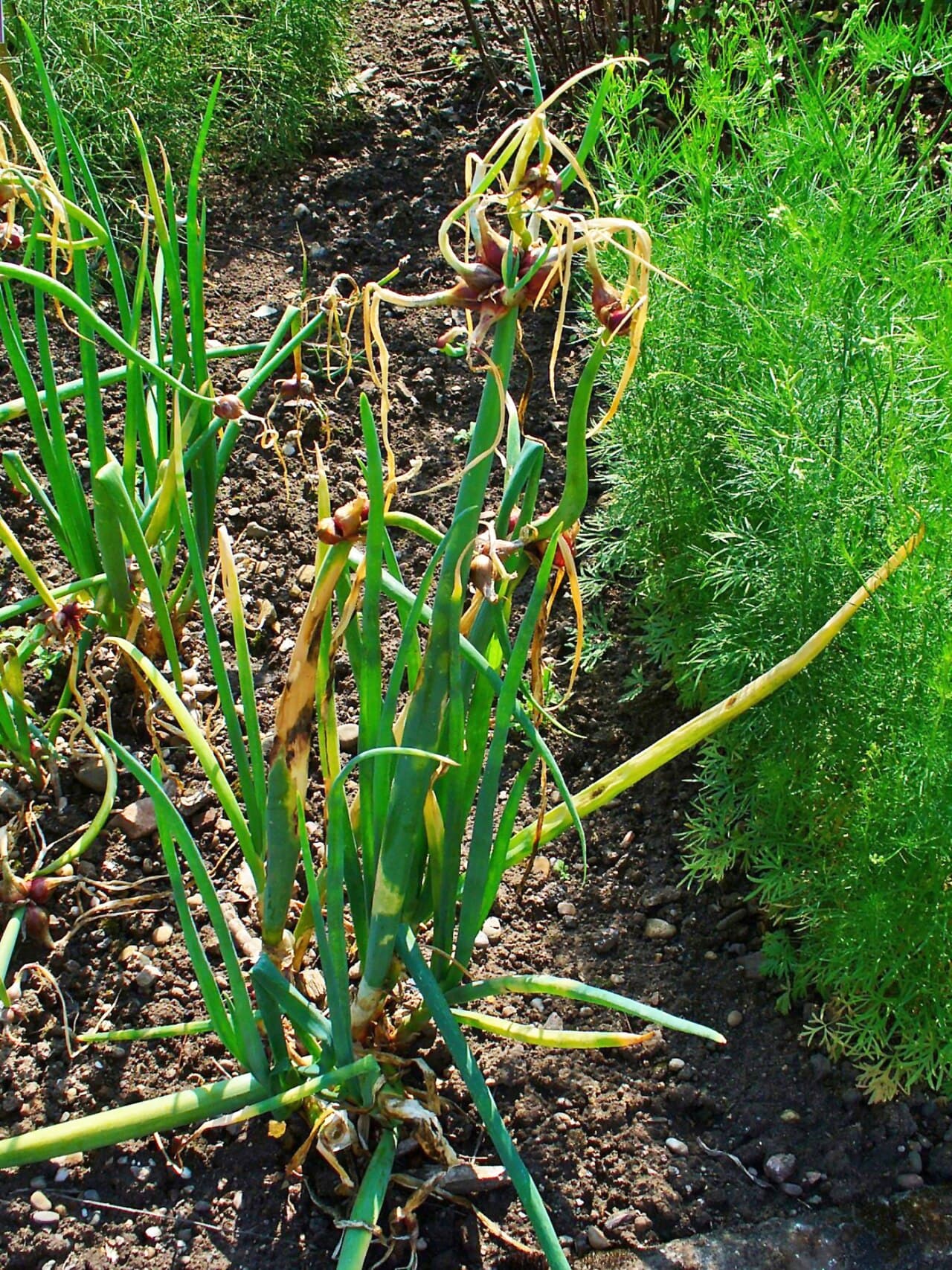
- A flower stalk coming up the middle: the bulb will not grow further — use it fresh.
- A thick, soft neck, meaning too much water — it will not store.
In Qatar
Bulbing starts in March when the day passes about 11 hours — which is exactly what "short-day variety" means.
Harvest and curing
Days 156–190The leaves flop over and dry from the tips — the plant’s own signal that the bulb is done. Curing after lifting is what lets it keep for months.
Do now
- Stop watering completely a week before lifting.
- Lift when two-thirds of the tops have bent over, then leave the bulbs in dry, airy shade for two weeks.
- Do not cure in direct Qatari sun — it scorches the outer skin.
Watch for
- Any moisture left in the neck at storage causes rot that spreads through the whole box.
- Bruises from rough lifting turning into rot spots.
In Qatar
Harvest April–May. Qatar’s dry air in those months is ideal for curing — in shade, never in the sun.
End of cycle
Days 191–220The plant’s cycle is over. The roots left behind break down and add organic matter if you leave them.
Do now
- Cut the plant at soil level and leave the roots in place to rot down.
- Sow a crop from a different family in the same spot to break the pest cycle.
- Add compost and cover the soil before the summer heat.
Watch for
- Planting the same family twice running in the same bed.
- Leaving the soil bare in the sun all summer.
In Qatar
Over as summer arrives. Well-cured onions will see you through to the next Al-Wasm.
- Water
- Medium
- Salt tolerance
- Medium
- Heat tolerance
- Medium
3 L/week in winter, 7 L in summer
Soil preparation
Weak, shallow roots that need fine, rich soil in the top 20 cm. Add compost and phosphorus before planting.
Pests
Onion thrips
- Sign
- Silvery streaks on the tubular leaves, worse as March warms.
- What to do
- Hose into the leaf bases, then neem oil. Thrips hide down in the folds.
Onion fly
- Sign
- Sudden yellowing and white maggots in the bulb.
- What to do
- Pull and destroy affected plants at once, and do not grow onions there next year.
Common problems
Onions that never bulb
- Cause
- A long-day variety unsuited to Qatar’s latitude (25° N). The most expensive mistake you can make with onions here.
- Fix
- Buy varieties explicitly labelled short-day. Check the packet before you buy — nothing fixes this later.
Flowering instead of bulbing
- Cause
- Oversized seedlings hit by Al-Murabbaniya cold.
- Fix
- Transplant seedlings no thicker than a pencil. Bigger ones read the cold as a signal to finish their life cycle.
Picking
Lift when two-thirds of the tops have flopped. Cure in airy shade for a fortnight before storing.
Keeping
Four months hung somewhere dry and shaded. Do not store with potatoes — their moisture rots it.