Radish
Also called: فجل · Fijl · Mooli
The fastest root crop — 25 days from seed to plate. Sow a batch every ten days from October for radishes all winter.
The year at a glance
Each month is split in half. The outline marks now.
Stage by stage
Stage 1 of 7
Seed
Days 0–2
Seed
Days 0–2The seed sits in the soil taking up water and swelling. Nothing shows above the surface — everything is happening underground.
Do now
- Water lightly and often so the soil stays damp but never soaked. Letting it dry out between waterings kills the seed before it sprouts.
- Cover the surface with a thin layer of straw or compost to slow evaporation and steady the temperature.
- Label what you sowed and when. You will need the date to work out the harvest.
Watch for
- A hard crust forming on sandy soil after watering, which traps the sprout underneath. Break it gently.
- Ants carrying small seeds away — a very common problem in Qatari gardens.
In Qatar
Sow where it will grow. Radish is never transplanted — any root disturbance means a deformed root.
Germination
Days 3–6The seed coat splits: a root pushes down and a shoot pushes up. The two seed leaves that appear are not true leaves — they are the seed’s own food store.
Do now
- Keep moisture constant. The first root is very fine and a single dry day can end the seedling.
- Remove any covering as soon as the first sprout shows, or it will stretch thin looking for light.
- Give bright, indirect light. Direct midday sun will scorch a new seedling within hours.
Watch for
- A long, thin, pale stem: the seedling is not getting enough light and will collapse.
- Sudden wilting with a pinched stem at soil level — damping off, caused by overwatering.
In Qatar
Up in three days in November. Its speed makes it the best crop for teaching children to garden.
Seedling
Days 7–12The first true leaves appear, shaped differently from the seed leaves. The plant is now feeding itself and the roots are branching fast.
Do now
- Thin crowded seedlings and keep the strongest. Crowding gives you many weak plants instead of one good one.
- Start watering less often but more deeply, to drive the roots downwards.
- Harden the seedling off — build up its sun exposure over a week before transplanting.
Watch for
- Yellowing lower leaves: nitrogen shortage, very common in Qatar’s poor sandy soil.
- Small holes or chewed edges, meaning snails or young grasshoppers.
In Qatar
Thin to 5 cm on day seven exactly. Thinning late is the number one cause of radish failure.
Top growth
Days 13–19The plant builds its leaves first. The root is still thin, but the size of the leaf canopy now decides the size of the root later.
Do now
- Thin to the recommended spacing. Crowding is the number one cause of small, deformed roots.
- Clear stones and clods from the soil around the plant. Any obstruction makes the root fork.
- Water regularly and deeply. Roots follow the water down.
Watch for
- Very lush leaves: too much nitrogen, and you will get foliage instead of a root.
- Compacted or very sandy soil stopping the root from expanding.
In Qatar
A very short stage — the plant makes only four or five leaves before everything goes into the root.
Root filling
Days 20–26The plant moves sugar from the leaves down into the root, which swells fast. You can often see the shoulder pushing above the soil.
Do now
- Keep watering perfectly steady. Swinging between dry and drenched splits the root.
- Cover any exposed shoulder with soil or mulch to stop it greening and going tough.
- Stop nitrogen completely and switch to potassium.
Watch for
- A lengthwise split in the root after a sudden heavy watering.
- Fine tunnels on the root surface, meaning root fly.
In Qatar
Keep the water dead steady for these seven days. Fluctuation here gives split or fiery radishes.
Harvest
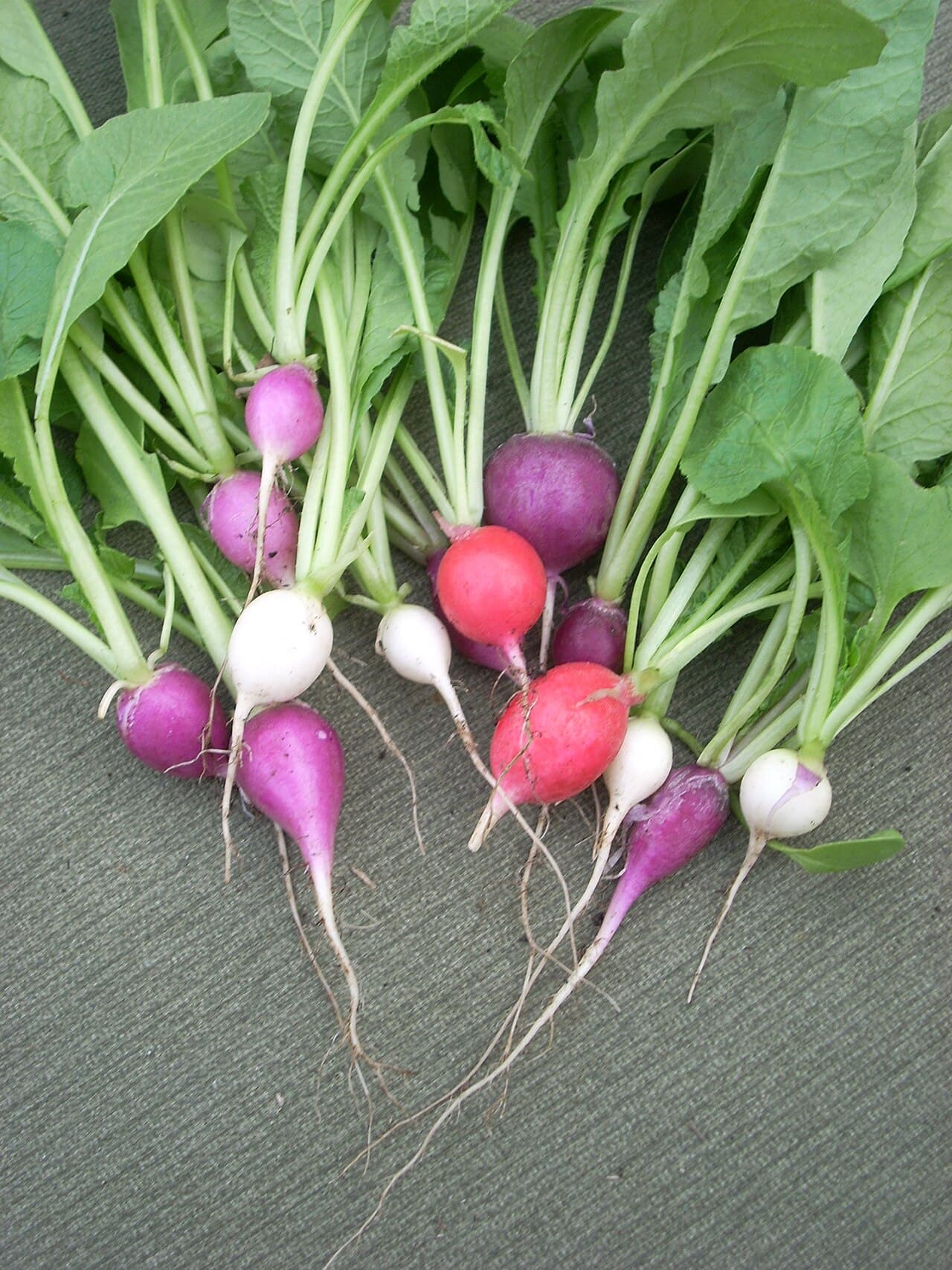
Days 27–42The root has reached size. Leaving it past this window makes it woody, hot-tasting or hollow.
Do now
- Water a few hours before lifting so the root pulls cleanly out of sandy soil.
- Lever from the side with a fork rather than pulling the leaves, which just snap off.
- Cut the tops off right after lifting, or they draw moisture out of the root.
Watch for
- A cracked or hollow root from harvesting too late.
- A sharp, hot taste, which means heat stress during growth.
In Qatar
The harvest window here is narrow — about two weeks. After that it goes woody even in a cold January.
End of cycle
Days 43–60The plant’s cycle is over. The roots left behind break down and add organic matter if you leave them.
Do now
- Cut the plant at soil level and leave the roots in place to rot down.
- Sow a crop from a different family in the same spot to break the pest cycle.
- Add compost and cover the soil before the summer heat.
Watch for
- Planting the same family twice running in the same bed.
- Leaving the soil bare in the sun all summer.
In Qatar
Sow the next batch straight away in the same spot after adding compost. Radish barely draws on the soil.
- Water
- Medium
- Salt tolerance
- Medium
- Heat tolerance
- Low
1.5 L/week in winter, 4 L in summer
Soil preparation
Only needs the top 15 cm, but it has to be fine and stone-free. Sieve the soil if you can.
Pests
Flea beetle
- Sign
- Many small shot-holes in the leaves.
- What to do
- Cover with fine mesh. Holed leaves do not stop the root forming but they slow it down.
Root fly
- Sign
- Fine brown tunnels inside the root.
- What to do
- Do not sow in the same spot twice running, and mesh from day one.
Common problems
All leaf, no root
- Cause
- Too much nitrogen, or sowing far too thickly.
- Fix
- Thin to 5 cm right after germination and skip nitrogen entirely.
Hollow, hot-tasting root
- Cause
- Harvesting late, or heat.
- Fix
- Harvest on day 25–30 exactly. Radish does not wait in this climate.
Picking
Pull as soon as the shoulder shows at 2–3 cm across. A single day’s delay makes a real difference.
Keeping
Cut the tops off at once and it keeps two weeks refrigerated. The leaves are edible cooked.