Dill
Also called: شبت · Shibint · Dill
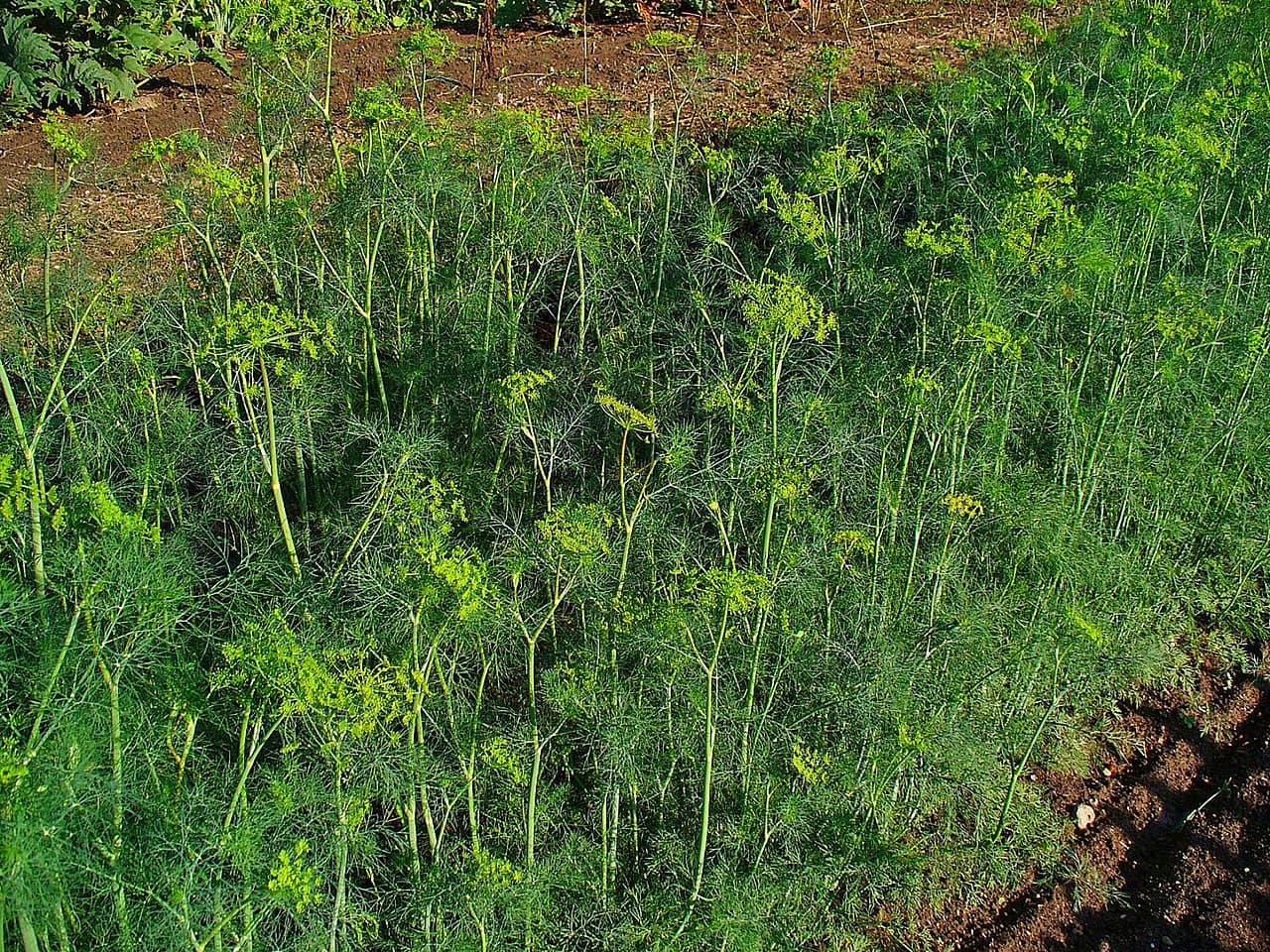
The herb of pickles, fish and salads. It grows fast in winter and flowers with March warmth, so sow small batches in a corner sheltered from the wind.
The year at a glance
Each month is split in half. The outline marks now.
Stage by stage
Stage 1 of 7
Seed
Days 0–6
Seed
Days 0–6The seed sits in the soil taking up water and swelling. Nothing shows above the surface — everything is happening underground.
Do now
- Water lightly and often so the soil stays damp but never soaked. Letting it dry out between waterings kills the seed before it sprouts.
- Cover the surface with a thin layer of straw or compost to slow evaporation and steady the temperature.
- Label what you sowed and when. You will need the date to work out the harvest.
Watch for
- A hard crust forming on sandy soil after watering, which traps the sprout underneath. Break it gently.
- Ants carrying small seeds away — a very common problem in Qatari gardens.
In Qatar
Sow where it will grow; dill sulks when moved. Cover with only 5 mm of soil — the seed needs light.
Germination
Days 7–14The seed coat splits: a root pushes down and a shoot pushes up. The two seed leaves that appear are not true leaves — they are the seed’s own food store.
Do now
- Keep moisture constant. The first root is very fine and a single dry day can end the seedling.
- Remove any covering as soon as the first sprout shows, or it will stretch thin looking for light.
- Give bright, indirect light. Direct midday sun will scorch a new seedling within hours.
Watch for
- A long, thin, pale stem: the seedling is not getting enough light and will collapse.
- Sudden wilting with a pinched stem at soil level — damping off, caused by overwatering.
In Qatar
Slow — up to two weeks. Keep the surface damp under a thin layer of fine compost.
Seedling
Days 15–27The first true leaves appear, shaped differently from the seed leaves. The plant is now feeding itself and the roots are branching fast.
Do now
- Thin crowded seedlings and keep the strongest. Crowding gives you many weak plants instead of one good one.
- Start watering less often but more deeply, to drive the roots downwards.
- Harden the seedling off — build up its sun exposure over a week before transplanting.
Watch for
- Yellowing lower leaves: nitrogen shortage, very common in Qatar’s poor sandy soil.
- Small holes or chewed edges, meaning snails or young grasshoppers.
In Qatar
Thin to 15 cm. In the northerly-wind season a simple windbreak saves a lot of seedlings.
Leaf growth
Days 28–39Leaves multiply fast and the rosette widens. All the energy goes into leaf — which is the crop itself, so speed is the goal.
Do now
- Feed nitrogen every ten days. Leafy crops want more of it than anything else you grow.
- Keep the moisture even. Any drought turns the leaves bitter and tough, permanently.
- Clear competing weeds. Leafy crops root shallowly and lose the competition easily.
Watch for
- Small, thick, dark leaves: the plant is thirsty or the soil is salty.
- Aphids gathering in the heart of the plant, where they are hard to wash out.
In Qatar
It grows tall and feathery fast, and its hollow stems snap in the wind. Grow it in a sheltered corner or beside a fence.
Cut and come again
Days 40–70The plant is at its most aromatic. Regular cutting makes it branch and produce more; leaving it uncut pushes it to flower.
Do now
- Cut from the top just above a pair of leaves, and the stem branches into two.
- Never take more than a third of the plant at once.
- Cut before the midday sun, when the aromatic oils are at their strongest.
- Pinch out any flower buds as soon as they appear to stretch the leaf season.
Watch for
- Woody stems at the base: the plant is ageing and needs a hard cut back or replacing.
- Spider mite in hot dry air, showing as faint speckling and fine webbing.
In Qatar
Snip from the outside. Dill leaf is at its best before the flower head forms in the cool of winter.
Bolting
Days 71–95Heat or lengthening days convince the plant its life is ending, so it rushes to make seed. The leaves turn bitter and tough.
Do now
- The leaves are past salad use. Cook them if the bitterness is bearable.
- Let the strongest plant finish flowering and collect its seed for another season.
- The flowers pull in beneficial insects, so leave some standing if you have another crop nearby.
Watch for
- Early bolting caused by sowing too late in the season — the commonest mistake in Qatar.
- Seed scattering itself and coming back as a weed next season.
In Qatar
It flowers in February and March. Let some stand: the yellow umbels attract hoverflies that eat aphids, and the seed is dill seed.
End of cycle
Days 96–115The plant’s cycle is over. The roots left behind break down and add organic matter if you leave them.
Do now
- Cut the plant at soil level and leave the roots in place to rot down.
- Sow a crop from a different family in the same spot to break the pest cycle.
- Add compost and cover the soil before the summer heat.
Watch for
- Planting the same family twice running in the same bed.
- Leaving the soil bare in the sun all summer.
In Qatar
Dill self-seeds freely. Scatter a little and it will come up on its own next Al-Wasm.
- Water
- Medium
- Salt tolerance
- Low
- Heat tolerance
- Low
2 L/week in winter, 6 L in summer
Soil preparation
A taproot that hates being moved, so sow it where it will grow. Work the soil to 20 cm with light compost. It is salt-sensitive, so flush the bed with fresher water if you can.
Pests
Aphids
- Sign
- Clusters on the feathery fronds and the flower rays.
- What to do
- Water blast. Leave some flowers standing: they draw ladybirds and hoverflies that eat aphids.
Swallowtail caterpillar
- Sign
- A green caterpillar striped black and yellow, eating the fronds fast.
- What to do
- Move it to another plant. It becomes a useful butterfly and rarely kills a well-grown plant.
Common problems
Stems snapping in the wind
- Cause
- The stems are tall, hollow and brittle, and the northerly winds of February and March are strong.
- Fix
- Grow it against a fence or among taller plants; sowing it thickly lets the stems hold each other up.
Early flowering
- Cause
- Heat above about 25 °C, transplant shock, or dry soil.
- Fix
- Sow in place, shade partly from February, and sow a fresh batch every fortnight.
Picking
Snip fronds from the outside before the flower head forms, when the leaf tastes best. Leave some flowers to give you dill seed.
Keeping
Three days in the fridge in a bag with a paper towel. Freezes chopped in ice cubes with oil.